

 EN
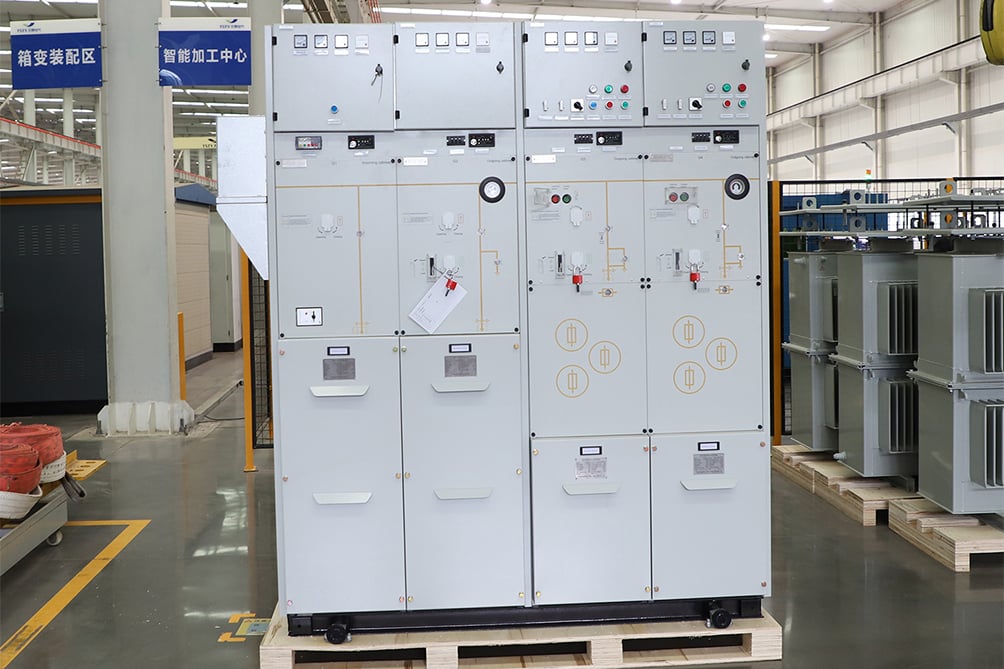
In the high-stakes realm of electrical transmission, utility developers and EPC (Engineering, Procurement, and Construction) contractors face a persistent dilemma when designing new infrastructure: should they deploy traditional Air Insulated Switchgear (AIS) or invest in a high voltage gas insulated switchgear (GIS)?
Historically, AIS was the default choice due to its lower initial capital cost. However, as global urbanization accelerates, land values skyrocket, and environmental regulations tighten, the mathematical and operational advantage has decisively shifted. Today, the high voltage gas insulated switchgear is the undisputed champion for modern, reliable power networks.
As one of the industry’s most experienced high voltage switchgear manufacturers, we routinely guide B2B procurement teams through this exact technical evaluation. This article breaks down the engineering differences, space requirements, and total cost of ownership, illustrating exactly why a high voltage gas insulated switchgear is the ultimate choice for your next major grid project.
To understand why a high voltage gas insulated switchgear outperforms traditional systems, one must look at the dielectric medium used to insulate the live conductors.
In an AIS setup, ambient air is used to prevent electrical arcing between the phases. Because air is a relatively weak insulator, the copper busbars in a 132kV or 220kV system must be spaced several meters apart. This results in sprawling, massive installations.
Conversely, a high voltage gas insulated switchgear encapsulates the circuit breakers, disconnectors, and busbars inside a grounded, hermetically sealed metallic enclosure filled with a dielectric gas (traditionally SF6, though eco-friendly alternatives are now available). This gas possesses a dielectric strength up to three times greater than air. Consequently, the internal components of a high voltage gas insulated switchgear can be placed mere millimeters apart safely.
This core technological difference is what allows a high voltage gas insulated switchgear to completely revolutionize substation design and layout.
The most immediate and striking advantage of a high voltage gas insulated switchgear is its spatial efficiency. In dense metropolitan areas or tightly packed industrial facilities, acquiring acres of land for a traditional AIS substation is often financially crippling or physically impossible.
Consider a standard 132 33kv substation designed for a city grid. If built using traditional AIS, this facility requires a massive outdoor plot to accommodate the sprawling high tension switchgear and necessary safety clearances.
By upgrading to a high voltage gas insulated switchgear, developers can reduce the total required footprint by up to 90%. A complete 132 33kv substation powered by a high voltage gas insulated switchgear can easily be housed within a multi-story basement, underneath a commercial skyscraper, or inside a compact, visually unobtrusive urban building. For procurement officers, the premium paid for a high voltage gas insulated switchgear is often entirely offset by the millions of dollars saved on land acquisition and civil engineering costs.
Power networks are increasingly being pushed into hostile environments—from offshore wind platforms in the corrosive North Sea to mining operations in the abrasive deserts of the Middle East.
An AIS system is fundamentally vulnerable to its environment. Salt, industrial pollution, sand, and severe humidity can settle on the exposed insulators, leading to tracking, partial discharge, and eventual catastrophic failure.
A high voltage gas insulated switchgear eliminates this risk entirely. Because all critical high-voltage components are sealed within a pressurized metal tank, the external environment has absolutely zero impact on the internal mechanisms. Whether facing a category-five hurricane or heavy industrial off-gassing, a high voltage gas insulated switchgear continues to operate flawlessly. This "fit and forget" reliability makes gis high voltage technology the only viable choice for mission-critical industrial sites.
When B2B buyers compare quotes from high voltage switchgear manufacturers, the initial Capital Expenditure (CAPEX) of a high voltage gas insulated switchgear is undeniably higher than that of an AIS equivalent. However, infrastructure is a 40-year investment. When evaluating the Total Cost of Ownership (TCO) or Operational Expenditure (OPEX), the financial narrative flips.
|
Operational Metric |
Air Insulated Switchgear (AIS) |
High Voltage Gas Insulated Switchgear |
|
Initial Purchase Price |
Lower |
Higher |
|
Land and Civil Costs |
Extremely High (Requires large acreage) |
Minimal (Fits in compact buildings/vaults) |
|
Maintenance Frequency |
High (Requires regular insulator cleaning) |
Practically Zero (Sealed for life) |
|
Environmental Outages |
Susceptible to weather, wildlife, and pollution |
100% immune to external factors |
|
Long-Term TCO |
High OPEX outweighs low CAPEX |
Lower TCO due to minimal maintenance & high uptime |
Because a high voltage gas insulated switchgear requires virtually no routine maintenance—aside from periodic gas pressure checks and automated digital monitoring—utility operators save exponentially on specialized labor and grid downtime over the lifespan of the equipment.
The reliability of a high voltage gas insulated switchgear is directly tied to the metallurgical and engineering precision of the factory that builds it. You cannot afford to treat this equipment as a simple commodity.
When evaluating a high voltage gas insulated switchgear supplier, procurement teams must audit the factory's sealing technology. The greatest risk to a high voltage gas insulated switchgear is a microscopic gas leak. Premium manufacturers assemble the core components in ISO-certified cleanrooms to prevent dust contamination. Furthermore, every high voltage gas insulated switchgear must undergo rigorous X-ray weld inspections and helium leak detection tests before leaving the factory. If a supplier cannot provide detailed Factory Acceptance Testing (FAT) reports for these specific metrics, they are not qualified to build your equipment.
The transition from AIS to a high voltage gas insulated switchgear is not merely an equipment upgrade; it is a strategic necessity for the modern grid. By shrinking the facility footprint by up to 90%, neutralizing all environmental threats, and drastically lowering long-term maintenance costs, a high voltage gas insulated switchgear secures the stability and profitability of your infrastructure.
For EPC contractors and utility developers, success lies in partnering with the right experts.
Are you planning a high-voltage transmission project? Do not compromise on the backbone of your power network. Contact our elite engineering team today to discuss your single-line diagrams, review our stringent manufacturing protocols, and custom-engineer a high voltage gas insulated switchgear that guarantees decades of absolute reliability for your grid.