

 EN
For an EPC (Engineering, Procurement, and Construction) contractor, urban power distribution is largely a matter of spatial negotiation. But when a project takes you completely off the grid—to a remote mining camp, a high-altitude telecom tower, or a rural agricultural pumping station—the engineering challenges change entirely.
In rugged, unpaved terrain, you cannot easily bring in a fleet of cement mixers to pour a 12-inch concrete slab. You cannot easily drive a 50-ton flatbed carrying a modular steel enclosure up a muddy, winding mountain logging road. When heavy civil engineering becomes logistically impossible or financially ruinous, the ultimate "off-road" grid solution is the pole mounted substation.
As a global manufacturer of heavy-duty electrical infrastructure, we supply equipment for some of the most unforgiving environments on the planet. Here is an inside look at how specifying a pole mounted substation circumvents severe logistical bottlenecks, dramatically cutting both CAPEX and installation time for remote power projects.
The greatest hidden cost of remote electrical deployment is earthmoving. Traditional ground-level distribution nodes require excavators to dig cable trenches, graders to level the earth, and concrete trucks to pour a foundation pad. If your site is 50 miles down a dirt road, getting that heavy machinery there will destroy your budget.
A pole mounted substation eliminates 90% of these civil works. Instead of leveling ground and pouring a concrete foundation, the installation crew only needs an auger truck (or manual labor in extreme cases) to dig deep holes for wooden, concrete, or steel utility poles. The entire structure of the pole mounted substation is built vertically.
Once the poles are set and guy-wired for tension, the cross-arms are bolted on, and the components are hoisted into the air. By utilizing a pole mounted substation, contractors can deploy a fully functional medium-voltage step-down node in a matter of days, completely bypassing the weeks required for ground leveling and concrete curing.
Because everything must hang in the air, weight is the defining constraint of a pole mounted substation. The configuration of the poles dictates the capacity of the transformer you can safely suspend.
Whether using a single pole or an H-frame, the primary advantage is that a pole mounted substation can be assembled piece-by-piece using a standard bucket truck or boom lift. You do not need the massive, expensive mobile cranes required to drop a prefabricated metal enclosure into place.
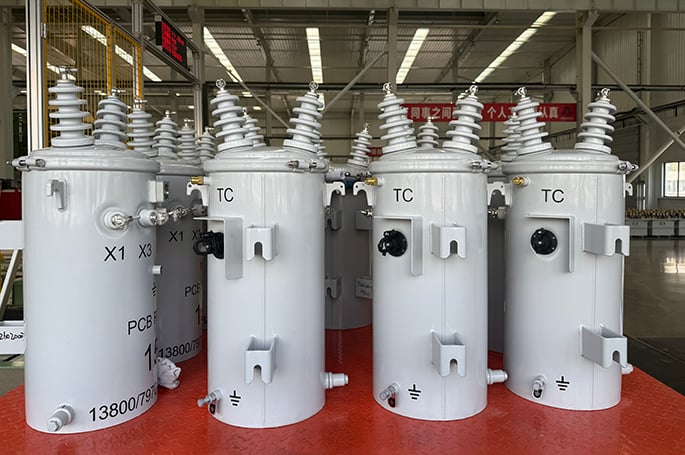
When you buy a complete pole mounted substation, you are not just buying a transformer. You are specifying a highly visible, vertically integrated safety ecosystem.
Because remote areas are prone to severe lightning storms and grid surges, a pole mounted substation must be equipped with localized protection. The high-voltage lines typically terminate at overhead cross-arms equipped with Lightning Arresters (Surge Arresters). Right below them sits the Drop-Out Fuse Cutouts (DOFC).
If a surge hits the 11kv pole mounted transformer, the DOFC blows, and the fuse tube physically swings downward to hang vertically. This is a massive maintenance advantage. A lineman patrolling a remote dirt road in a pickup truck can simply look up at the pole mounted substation and instantly see the hanging drop-out fuse. They know exactly which phase tripped without having to unlock a cabinet or hook up diagnostic equipment.
Ground-level infrastructure is highly vulnerable to ground-level threats. In remote valleys, a flash flood can submerge a metal electrical cabinet in minutes. In alpine regions, heavy snowdrifts can bury ground-mounted cooling fins, causing the transformer to overheat and trip. Furthermore, in wild environments, grazing livestock or rodents frequently chew through low-lying cables.
By elevating your assets 15 to 25 feet in the air, a pole mounted substation gains near-total immunity to these environmental hazards.
|
Environmental Threat |
Ground-Level Equipment |
Elevated Pole Mounted Substation |
|
Flash Flooding |
High risk of short circuit and water ingress. |
Zero risk (Equipment is far above flood lines). |
|
Heavy Snow Accumulation |
Blocks ventilation, causes thermal tripping. |
Snow cannot accumulate on aerial cooling fins. |
|
Vandalism & Wildlife |
Accessible to unauthorized personnel and animals. |
Inaccessible without specialized climbing gear/bucket trucks. |
As a manufacturer, we highly advise procurement teams to scrutinize the exterior durability of their aerial equipment. A pole mounted distribution transformer is continuously exposed to punishing UV radiation, driving rain, and gale-force winds.
When ordering a pole mounted substation for a remote project, do not accept standard indoor-rated paint. Insist on a heavy-duty, C4 or C5 marine-grade anti-corrosion coating for the transformer tank. Furthermore, all the mounting brackets, cross-arms, and hardware on the pole mounted substation must be hot-dip galvanized. If a bracket rusts and snaps in a remote jungle, the resulting transformer drop can cause a devastating forest fire.
Finally, consider the altitude. If your pole mounted substation is being deployed in a high-mountain mining facility (above 1,000 meters), the thinner air reduces the dielectric strength of the insulation. You must explicitly ask your manufacturer to provide high-creepage porcelain or polymer insulators to prevent high-voltage arcing.
Bringing stable electricity to the edges of the map requires a pragmatic approach to logistics. You cannot fight the terrain; you have to engineer above it.
For decades, the pole mounted substation has been the undisputed champion of rural and remote electrification. By completely eliminating the need for poured concrete, heavy earthmoving, and specialized road access, a pole mounted substation slashes logistical headaches and dramatically accelerates your project timeline.
When you partner with an experienced B2B manufacturer to source your aerial equipment, you guarantee that every bracket, fuse, and transformer tank is engineered to survive decades of isolation. If your next project lies at the end of a long, unpaved road, look upward—the pole mounted substation is your most reliable path to power.